DPI Series Part 2: How Aadhaar Authentication API Flow Works
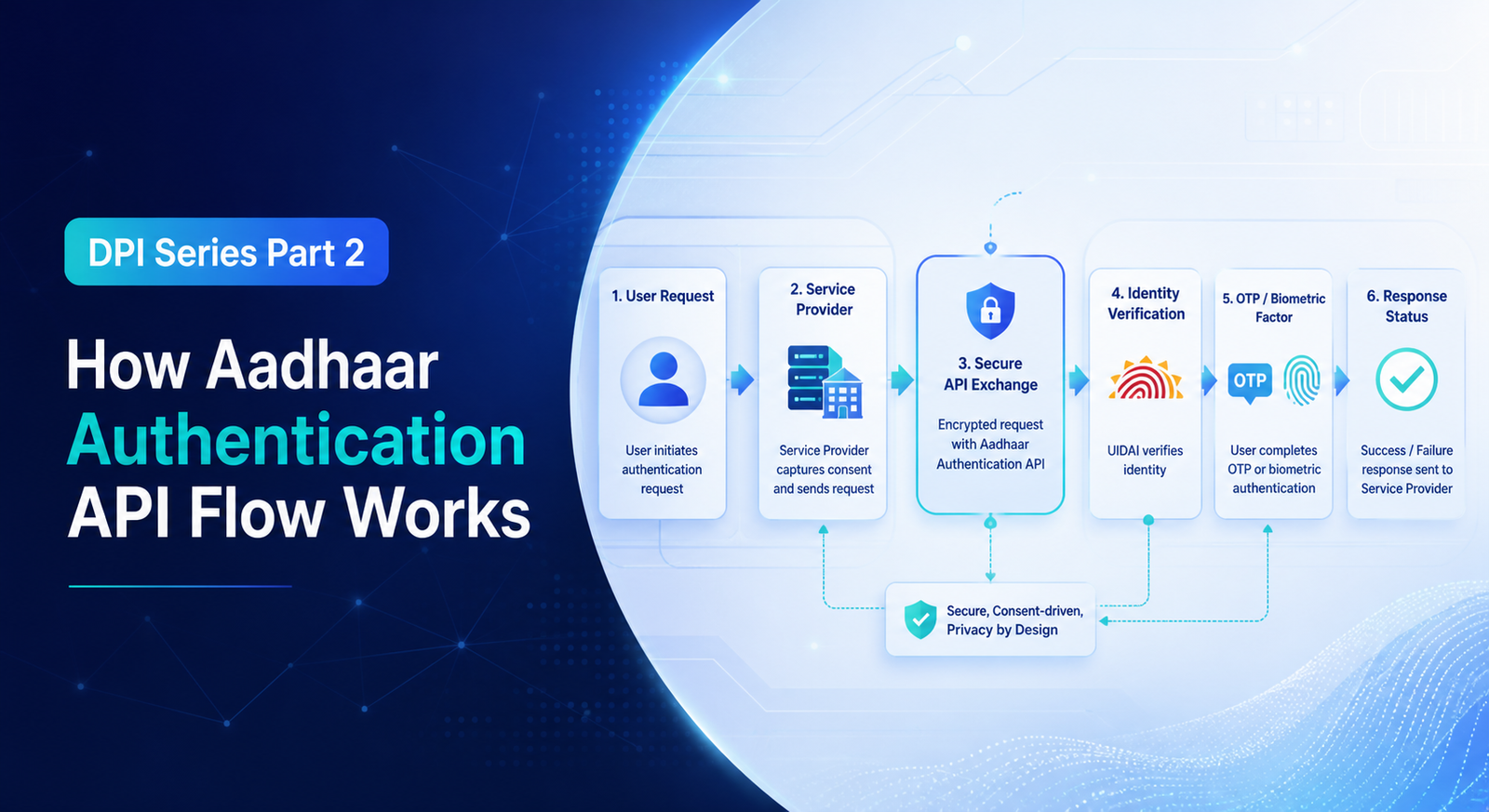
Aadhaar authentication is often seen as a simple user verification step, but from an engineering perspective it represents a structured backend trust flow. Behind the user action, multiple checks and secure request exchanges help confirm identity in a controlled way.
For engineers, the main lesson is how a digital identity platform handles request validation, response processing, and trusted system communication at scale.
A High-Level Authentication Flow
Aadhaar authentication usually starts when a user provides an identifier and an authentication factor such as OTP or biometrics.
At a simplified level, the flow looks like this:
User Request
      ↓
Application or Service Provider
      ↓
Authentication Request Processing
      ↓
Identity Verification System
      ↓
Success or Failure Response
This type of flow helps separate the user-facing product from the identity verification backend.
What Engineers Can Learn
Important engineering concepts in this type of API flow include:
- Request validation
- Secure payload exchange
- Response correlation
- Error and retry handling
- Audit and traceability
These are useful patterns in any identity-heavy system, not only public infrastructure.
More Than a Simple Login Check
Aadhaar authentication highlights how identity systems must balance speed, reliability, and trust. Even when the user sees only one screen, the backend design has to support accuracy, security, and operational scale.
Conclusion
The Aadhaar authentication flow shows engineers how trusted identity systems are designed around secure requests, controlled verification, and reliable responses. It is a strong example of backend-first thinking in real-world digital infrastructure.
Connect With Us
At KIS Technology, we help businesses transform their ideas into secure and scalable digital solutions through software development, API integration, and quality engineering.
Build smarter. Build securely. Build for growth.
Connect with our Founder: