The EDI Monitoring Metrics Every Ops Team Should Track
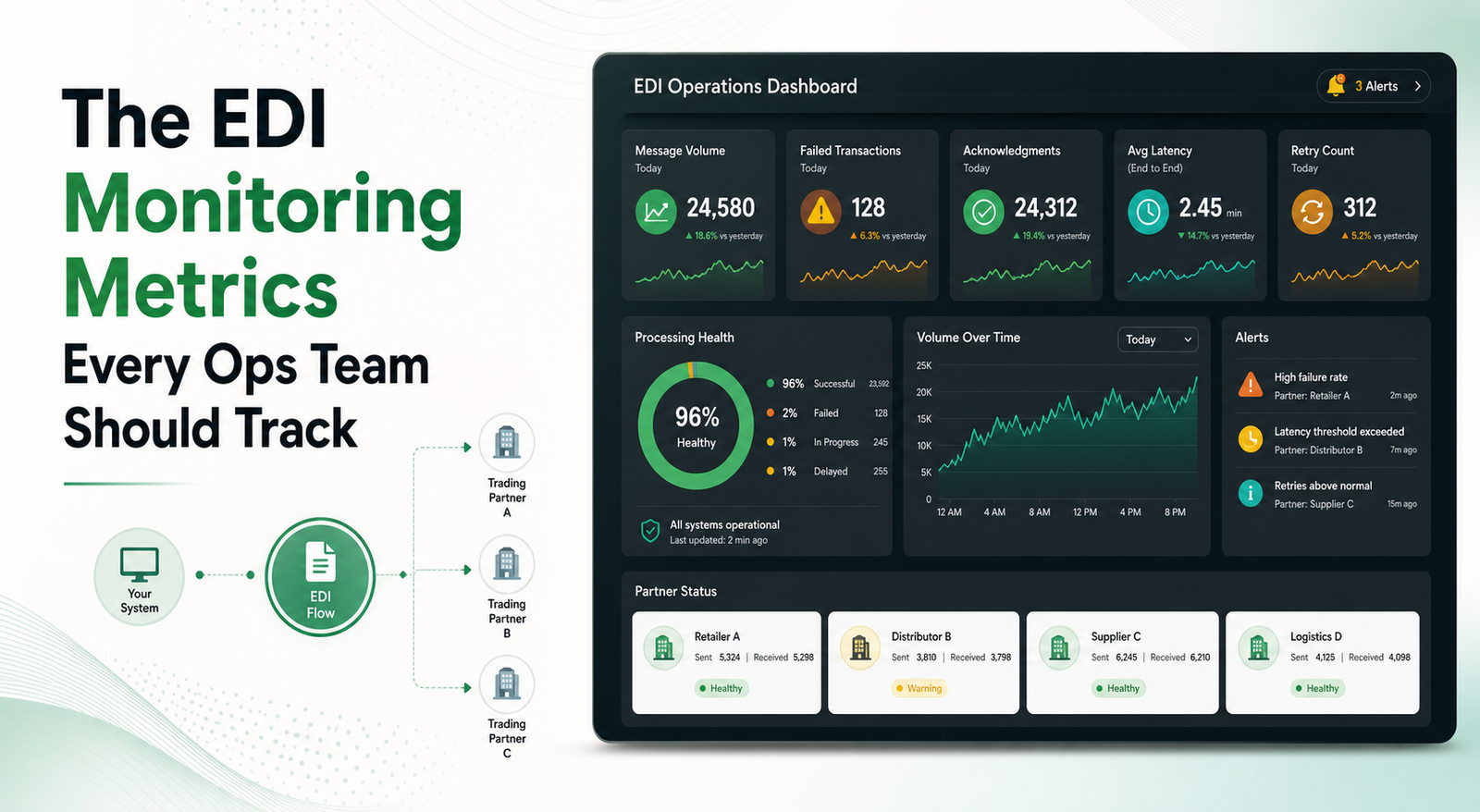
EDI operations teams need more than a basic success or failure view. To keep trading partner integrations reliable, they need clear monitoring metrics that show message health, delays, acknowledgments, and exception trends across the platform.
When the right metrics are tracked consistently, teams can detect issues faster, reduce partner disruptions, and improve overall operational control. This is especially important in environments handling high message volume, multiple protocols, and time-sensitive business documents.
Why EDI Monitoring Metrics Matter
EDI workflows involve many moving parts. Messages may pass through AS2, SFTP, validation, mapping, routing, acknowledgments, and downstream delivery stages.
If teams only react after a business complaint, the issue may already have affected orders, invoices, or shipments. Monitoring helps identify problems earlier and gives operations teams a stronger view of system health.
Key Metrics Every Ops Team Should Track
Some of the most useful EDI monitoring metrics include:
- Total messages processed
- Failed message count
- Acknowledgment success rate
- Validation error rate
- Average processing time
- Duplicate message count
- Partner-wise exception volume
These metrics help teams understand whether problems are isolated, increasing, or linked to a specific trading partner or document flow.
A Simple Monitoring View
A typical monitoring flow may look like this:
Inbound Messages
       ↓
Validation and Mapping
       ↓
Routing and Delivery
       ↓
Acks, Errors, and Exceptions
       ↓
Dashboard Metrics and Alerts
This structure gives operations teams visibility across the full message lifecycle.
Metrics That Improve Faster Response
Not every metric has the same operational value. For example, a total message count is useful, but delayed acknowledgments or rising validation errors often require faster attention.
Ops teams should prioritize metrics that reveal:
- Partner-specific failures
- Backlogs in message processing
- Missing acknowledgments
- Sudden spikes in exceptions
- Repeated duplicate or retry activity
These indicators can help teams act before business users notice a disruption.
Use Alerts with Metrics
Metrics become more useful when paired with alerts. For example, if acknowledgment rates drop or validation errors rise beyond a threshold, the system should notify the operations team automatically.
This reduces manual monitoring effort and helps teams respond faster to urgent issues.
Conclusion
The EDI monitoring metrics every ops team should track are the ones that improve visibility, speed up issue response, and protect trading partner reliability. Strong monitoring helps EDI operations stay proactive instead of reactive.
Connect With Us
At KIS Technology, we help businesses transform their ideas into secure and scalable digital solutions through software development, API integration, and quality engineering.
Build smarter. Build securely. Build for growth.
Connect with our Founder: