Headless vs Traditional E-commerce: Which Architecture Should You Choose?
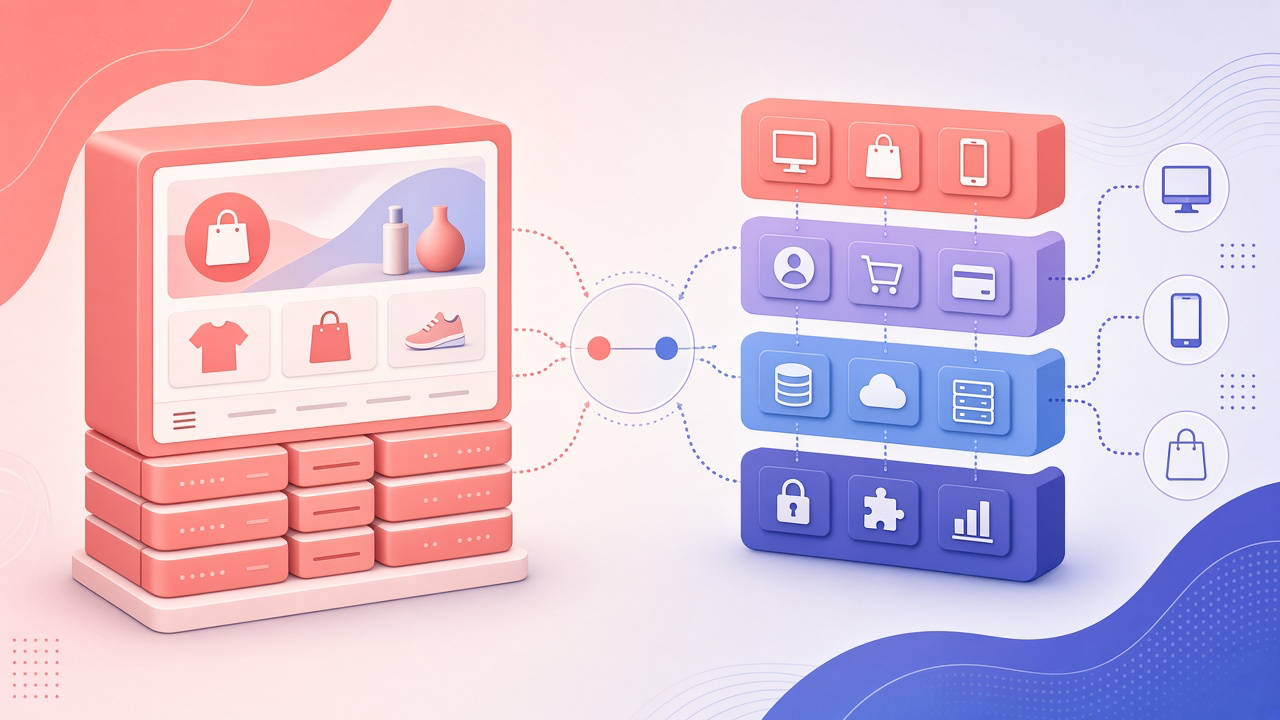
Traditional e-commerce platforms ship the storefront and commerce engine together. Headless commerce separates the frontend experience from the backend services and connects them with APIs. Both can sell products well. The right choice depends on channels, team shape, and how fast you need to change the buying experience.
Traditional Commerce in Simple Terms
A traditional (monolithic or coupled) platform usually provides:
- Theme-based storefront
- Catalog, cart, checkout, and orders in one product
- Built-in CMS or page builder
- Plugins for payments, tax, and shipping
You configure more than you compose. Launch can be fast if your needs fit the platform’s defaults.
Headless Commerce in Simple Terms
Headless keeps commerce capabilities—catalog, cart, checkout, promotions, inventory—as services. The storefront is a separate app (web, mobile, kiosk, marketplace widget) that calls those services through APIs.
You compose more than you configure. Frontends can change without waiting for a full platform upgrade.
Side-by-Side Comparison
| Factor | Traditional | Headless |
|---|---|---|
| Time to first storefront | Often faster with themes | Longer until APIs and frontend glue exist |
| Unique UX / brand sites | Limited by theme model | Strong fit |
| Mobile apps + web | Often secondary | Natural multi-channel |
| Team skills | Platform admins + light frontend | Strong frontend + API engineering |
| Total cost | License + plugins | Platform + custom frontend + ops |
| Upgrade risk | Theme and plugin breakage | API contract and integration risk |
When Traditional Is the Better Fit
Choose traditional when:
- You need a solid web store quickly
- Catalog and checkout are standard for your category
- Your team is stronger at merchandising than custom engineering
- One primary channel (the website) drives most revenue
- Budget favors configuration over building a design system and BFF layer
Many mid-market brands succeed for years on a well-run coupled platform.
When Headless Is the Better Fit
Choose headless when:
- You need the same commerce brain across web, app, and in-store screens
- Brand experience is a competitive advantage
- You integrate many backend systems (PIM, OMS, ERP, custom pricing)
- Frontend release velocity must outpace platform release cycles
- You already have engineers comfortable with API-first delivery
Headless is not automatically “more modern.” It is more flexible—and more work to operate well.
Hybrid Reality
Many teams run a hybrid:
- Coupled admin and catalog tools
- Headless or custom storefront for high-traffic experiences
- Shared checkout APIs for app and web
Architecture labels matter less than clear ownership of cart, price, inventory truth, and order create.
Decision Checklist
Ask:
- How many customer channels need a first-class experience this year?
- Can our current theme model express the UX we need?
- Do we have frontend capacity to own a storefront long term?
- Are checkout, tax, and promotions already custom enough that the monolith fights us?
- What is the cost of a slow storefront change versus a longer initial build?
If answers point to one channel and fast launch, traditional usually wins. If answers point to multi-channel and custom journeys, headless earns its complexity.
Implementation Tips If You Go Headless
- Put a backend-for-frontend between clients and commerce APIs
- Keep cart and price calculations server-side
- Design API contracts and versioning early
- Measure Core Web Vitals on the custom storefront from day one
- Do not rebuild OMS and ERP; integrate them
Conclusion
Traditional e-commerce optimizes for packaged speed. Headless optimizes for experience flexibility across channels. Choose based on business constraints and team skills, not based on what is trending in architecture blogs.
Connect With Us
At KIS Technology, we help businesses transform their ideas into secure and scalable digital solutions through software development, API integration, and quality engineering.
Build smarter. Build securely. Build for growth.
Connect with our Founder: