FinTech Transaction Processing: How to Build Reliable, Real-Time Financial Workflows
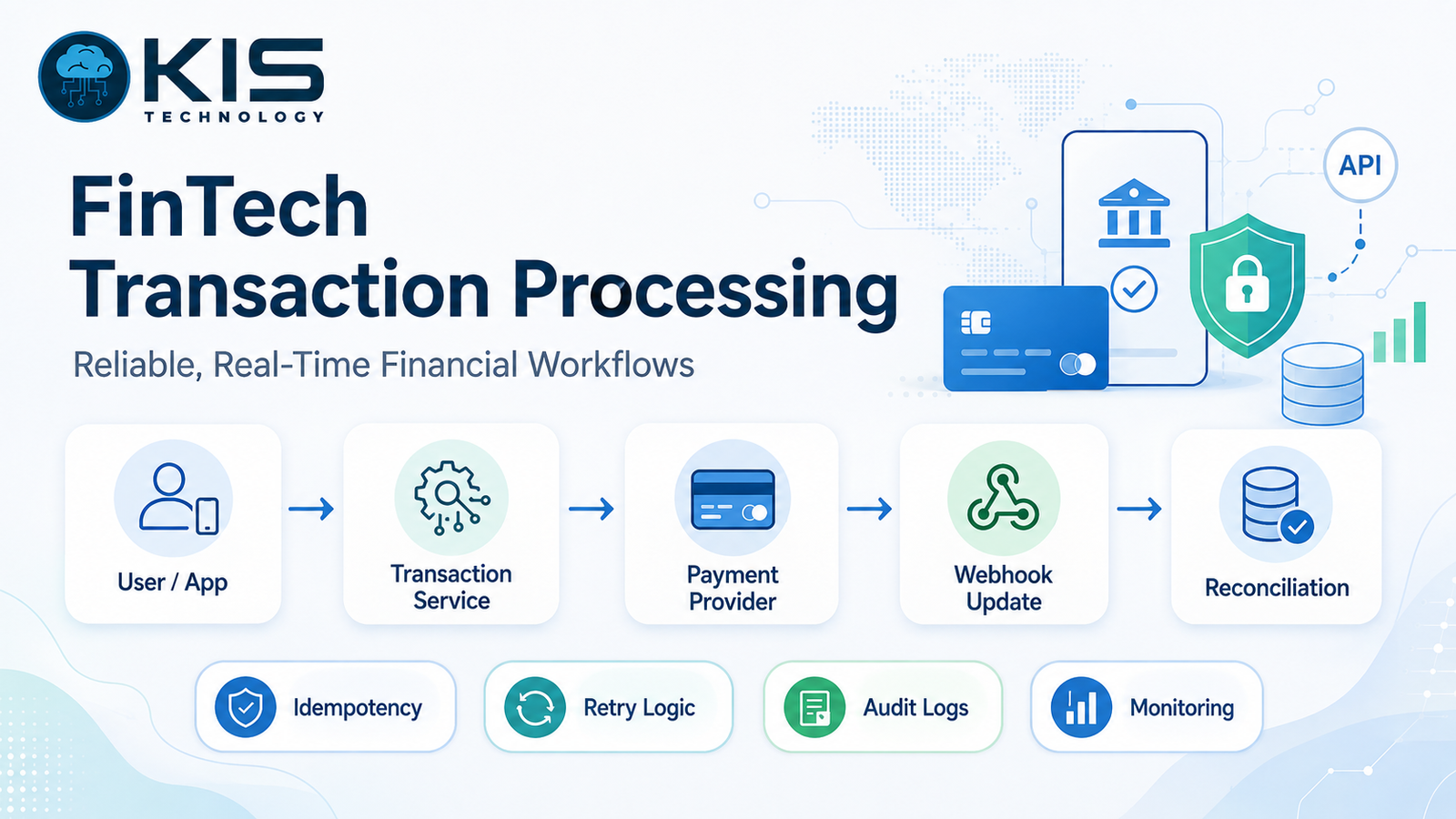
Modern FinTech applications process financial transactions in seconds. From initiating a payment to receiving confirmation, users expect the entire experience to be fast, secure, and reliable.
Behind a simple "Payment Successful" message, however, multiple systems may be communicating with each other.
A reliable FinTech platform must correctly manage transaction states, duplicate requests, external APIs, retries, webhooks, reconciliation, and monitoring.
Let's understand how a real-time financial workflow can be designed.
Understanding the Transaction Flow
A typical transaction may travel through several systems before it is completed.
User
  ↓
Web / Mobile Application
  ↓
FinTech Backend
  ↓
Payment Provider
  ↓
Bank / Financial Network
  ↓
Transaction Response
The backend plays an important role because it controls the transaction lifecycle and maintains the application's trusted record of what happened.
A transaction should normally have its own unique identifier so it can be tracked throughout this process.
Managing Transaction Status
Financial transactions should not be treated as simply successful or failed.
A transaction can move through several states:
Created
   ↓
Pending
   ↓
Processing
  ↙       ↘
Success   Failed
Depending on the system, additional statuses may include:
- Initiated
- Authorized
- Completed
- Declined
- Cancelled
- Refunded
- Reversed
For example, a payment provider may initially return a Pending response while the bank is still processing the transaction.
The application should not incorrectly display it as failed just because a final response was not immediately available.
Prevent Duplicate Transactions with Idempotency
Duplicate processing is one of the most important risks in financial applications.
Imagine a customer clicks the Pay button twice because the first request takes several seconds to complete.
Without protection:
Payment Request
      ↓
₹5,000 Processed

Second Request
      ↓
₹5,000 Processed Again ❌
An idempotency key can help prevent this situation.
The client or backend generates a unique key for the transaction:
Request
  ↓
Idempotency Key: TXN-12345
  ↓
Backend checks previous request
If the same request arrives again with the same key, the system can return the existing result instead of processing another financial transaction.
Handle Retries Carefully
External financial services may occasionally fail because of:
- Network timeouts
- Temporary service outages
- API errors
- Database connectivity issues
- Provider downtime
Retry mechanisms can improve reliability, but retries must be controlled.
A common approach is:
Transaction Request
       ↓
External Provider
       ↓
Temporary Failure
       ↓
Retry Queue
       ↓
Retry Transaction
The system should use retry limits and delays between attempts.
Combining retries with idempotency is especially important because a timeout does not always mean the original transaction failed.
The provider might have completed the payment even though your application did not receive the response.
Use Webhooks for Final Transaction Updates
Many payment and financial providers use webhooks to notify applications when transaction status changes.
For example:
FinTech Application
        ↓
Create Payment
        ↓
Payment Provider
        ↓
Payment Processing
        ↓
Webhook
        ↓
Update Transaction Status
Suppose the initial API response says:
Status: PENDING
A few seconds later, the provider may send a webhook:
Status: SUCCESS
The backend can then update the transaction and notify the frontend.
Webhook implementations should verify that requests actually came from the trusted provider, typically through signatures or other authentication mechanisms.
Reconciliation Keeps Financial Records Accurate
Even with good APIs and webhooks, discrepancies can occur.
For example:
Application Status: PENDING
Provider Status: SUCCESS
This can happen if a webhook was delayed or temporarily failed.
Reconciliation compares the application's transaction records with records from the payment or financial provider.
A reconciliation process may look like:
Application Transactions
          ↓
        Compare
          ↑
Provider Transactions
          ↓
Identify Mismatches
          ↓
Correct / Investigate
Reconciliation provides an additional reliability layer for financial systems.
Maintain Complete Audit Logs
Financial transactions should always be traceable.
An audit record may include:
- Transaction ID
- User or account reference
- Transaction amount
- Transaction type
- Current status
- Provider reference ID
- Created timestamp
- Updated timestamp
- Retry attempts
- Webhook events
- Failure reason
For example:
Transaction: TXN-12345
Amount: ₹5,000
Status: SUCCESS
Provider Reference: PAY-98765
Retries: 0
Webhook: Received
Audit logs help development, support, finance, and operations teams investigate transaction issues.
They can also support compliance and reporting requirements.
Monitoring and Alerts
A production FinTech platform should continuously monitor transaction processing.
Useful metrics include:
- Total transactions
- Successful transactions
- Failed transactions
- Pending transactions
- Average processing time
- Provider API failures
- Webhook failures
- Retry count
- Reconciliation mismatches
For example, if the normal transaction success rate suddenly drops, monitoring tools should generate an alert.
Normal Success Rate
      ↓
     98%
      ↓
Suddenly Drops
      ↓
     65%
      ↓
Alert Operations Team
This allows teams to investigate problems before they affect a large number of customers.
A Reliable FinTech Transaction Architecture
Putting these components together, a modern architecture may look like:
Web / Mobile App
       ↓
     API Layer
       ↓
Transaction Service
       ↓
Idempotency Check
       ↓
Payment Provider
       ↓
Bank / Financial Network
       ↓
Webhook Processing
       ↓
Transaction Database
       ↓
Reconciliation
       ↓
Monitoring & Audit Logs
Each component helps make the transaction workflow more reliable and easier to troubleshoot.
Conclusion
Reliable FinTech transaction processing requires much more than calling a payment API.
A production-ready financial workflow should include:
- Clear transaction states
- Idempotency protection
- Controlled retry mechanisms
- Secure webhook processing
- Reconciliation
- Complete audit logs
- Real-time monitoring and alerts
When these components work together, FinTech applications can process transactions more securely, prevent duplicate operations, recover from temporary failures, and provide better visibility into every financial workflow.
For modern FinTech platforms, reliability and traceability are just as important as transaction speed.
Connect With Us
At KIS Technology, we help businesses transform their ideas into secure and scalable digital solutions through software development, API integration, and quality engineering.
Build smarter. Build securely. Build for growth.
Connect with our Founder: