EDI Explained: How Electronic Data Interchange Works in the USA
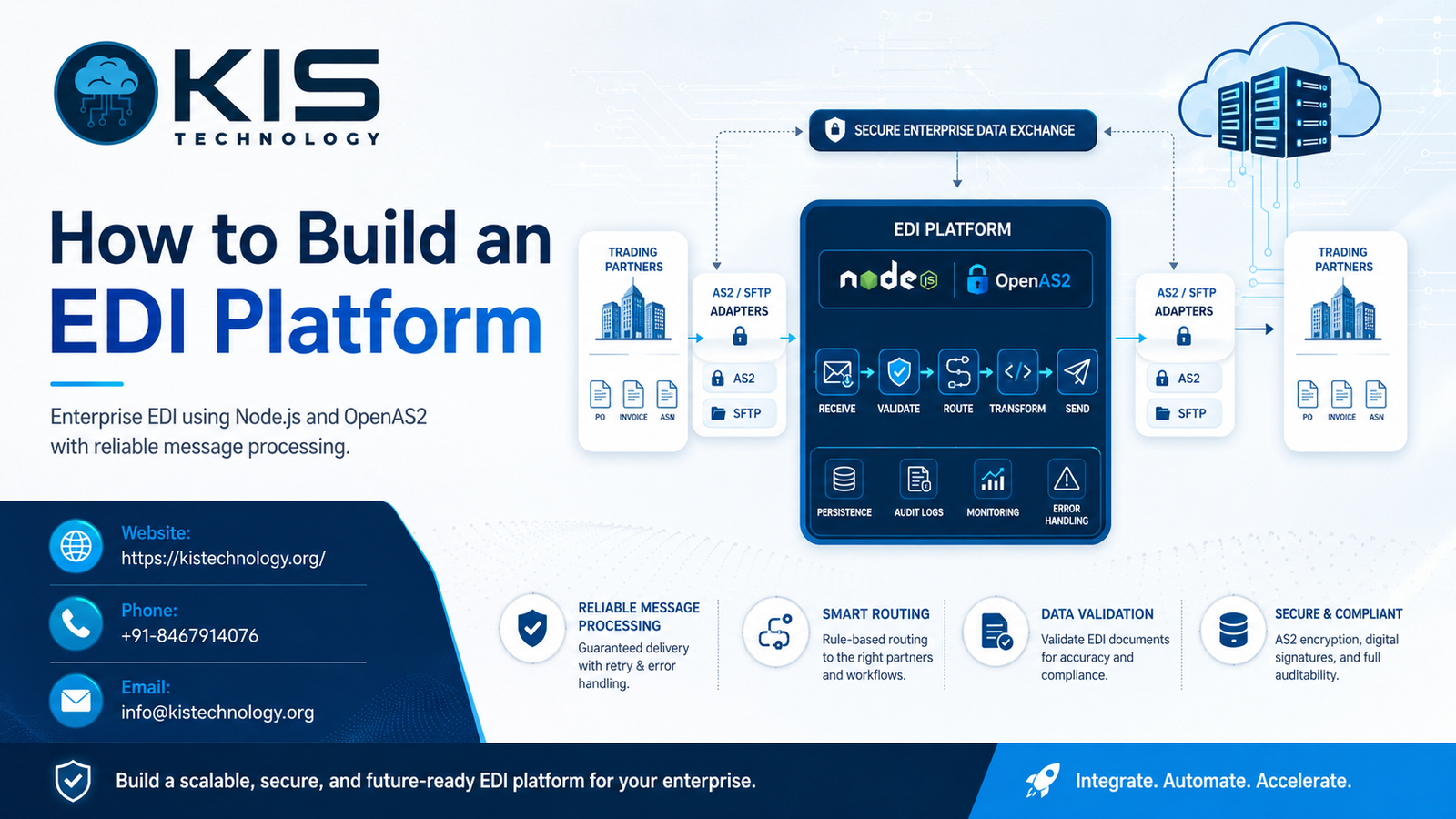
Electronic Data Interchange, commonly known as EDI, enables businesses to exchange structured business documents electronically between their systems.
Instead of sending purchase orders, invoices, or shipment information manually through email, spreadsheets, or paper documents, EDI allows this information to move automatically in a standardized format.
In the United States, EDI is widely used across industries such as retail, logistics, manufacturing, healthcare, automotive, finance, and supply chain management.
What is EDI?
EDI is a standardized method of exchanging business information directly between computer systems.
For example, when a retailer places an order with a supplier, the retailer's system can automatically generate and send an electronic purchase order. The supplier can then process that data without manual re-entry.
This helps businesses reduce manual work, improve accuracy, and process transactions faster.
EDI Standards in the USA
One of the most widely used EDI standards in the United States is ANSI X12.
ANSI X12 defines standardized formats for different types of business transactions.
Some commonly used X12 transaction sets include:
- 850 - Purchase Order
- 810 - Invoice
- 856 - Advance Ship Notice
- 855 - Purchase Order Acknowledgment
- 846 - Inventory Inquiry/Advice
- 940 - Warehouse Shipping Order
- 945 - Warehouse Shipping Advice
- 997 - Functional Acknowledgment
Each transaction has a predefined structure so that different organizations can exchange information consistently.
How an EDI Transaction Works
A typical EDI transaction follows a simple process:
- A business application creates a document such as a purchase order or invoice
- The EDI platform converts it into a standard format like ANSI X12
- The file is transmitted through a protocol such as AS2 or SFTP
- The trading partner receives and validates the document
- Acknowledgements confirm receipt and document acceptance
This process helps ensure that business documents reach the correct partner securely and can be processed reliably.
Trading Partners
Companies exchanging EDI documents with each other are commonly referred to as trading partners.
Each trading partner may have its own configuration.
This configuration may include:
- Sender ID
- Receiver ID
- Supported transaction types
- AS2 identifiers
- SFTP credentials
- Certificates
- Encryption requirements
- Document mappings
- Acknowledgement requirements
A good EDI platform manages these configurations centrally.
How EDI Documents are Transferred
EDI standards define the structure of business documents, while communication protocols determine how those documents are transmitted.
Common EDI communication methods include:
AS2
AS2 (Applicability Statement 2) is widely used for secure business-to-business document exchange.
AS2 commonly provides:
- Encryption
- Digital signatures
- Secure HTTP-based communication
- Message integrity
- Delivery acknowledgement through MDNs
SFTP
SFTP (Secure File Transfer Protocol) is another common method for exchanging EDI files.
With SFTP, organizations typically upload and download EDI documents from secure configured directories. The EDI application then processes incoming files and routes them to the appropriate workflow.
What is an AS2 MDN?
When a message is exchanged using AS2, the receiving system can send an MDN - Message Disposition Notification.
The MDN confirms whether the AS2 message was successfully received and processed at the transport level.
MDNs are important because they provide evidence that the message reached the receiving AS2 system.
What is a 997 Functional Acknowledgment?
A 997 Functional Acknowledgment is an ANSI X12 transaction used to indicate whether another X12 document was structurally received and evaluated.
A 997 can indicate whether the transaction was accepted or whether structural problems were detected.
MDN vs 997
MDN and 997 acknowledgements serve different purposes.
MDN
An MDN relates primarily to the AS2 transport layer.
It confirms that the AS2 message was received.
997
A 997 relates to the EDI document layer.
It indicates whether the X12 transaction was structurally accepted or rejected.
Understanding the difference between these two acknowledgements is important when troubleshooting EDI integrations.
EDI Message Processing
After receiving an EDI document, an enterprise EDI platform normally performs several processing steps.
Typical processing includes:
- Receiving the document through AS2, SFTP, or another channel
- Identifying the correct trading partner configuration
- Validating the document structure and control data
- Parsing and transforming EDI data into a usable internal format
- Routing the document to the correct business workflow
- Generating acknowledgements where required
These steps help create reliable and repeatable EDI processing across partners and transaction types.
Duplicate Message Detection
EDI systems must also protect against duplicate transactions.
A trading partner may resend a message because of:
- Network failures
- Missing acknowledgements
- Timeout errors
- Retry mechanisms
- Integration failures
Without duplicate detection, the same purchase order or invoice could potentially be processed more than once.
EDI platforms can identify duplicates using information such as:
- AS2 Message ID
- ISA Control Number
- GS Control Number
- ST Transaction Control Number
EDI Error Handling
Reliable error handling is one of the most important parts of an EDI platform.
Common problems include:
- Invalid X12 document structure
- Duplicate messages
- Unknown trading partners
- Incorrect sender or receiver IDs
- AS2 certificate errors
- SFTP connection failures
- Missing MDNs
- Missing acknowledgements
- Invalid control numbers
- Document mapping failures
A reliable EDI system should not simply discard failed transactions. Instead, failed messages should be logged, monitored, and made available for controlled reprocessing.
EDI Monitoring and Audit Logs
Enterprise EDI environments may process thousands of business documents, making monitoring essential.
An EDI dashboard should provide information such as:
- Message ID
- Trading partner
- Transaction type
- Received date and time
- Processing status
- MDN status
- 997 status
- Retry count
- Error details
Maintaining detailed audit logs also helps businesses investigate transaction failures and track the complete lifecycle of a document.
Benefits of EDI
EDI provides several benefits to businesses.
Faster Processing
Transactions can move automatically between business systems without waiting for manual data entry.
Reduced Human Errors
Because information is exchanged directly between systems, businesses can reduce mistakes caused by manually entering data.
Automation
Purchase orders, invoices, shipment notices, inventory updates, and acknowledgements can be processed automatically.
Better Visibility
EDI platforms provide centralized tracking of transactions between organizations.
Scalability
A well-designed EDI platform can support many trading partners and large transaction volumes.
Modern EDI Architecture
Modern EDI systems often combine traditional EDI technologies with modern application architectures. Technologies such as Node.js, OpenAS2, message queues, databases, APIs, and monitoring services can work together to create scalable enterprise EDI platforms.
Conclusion
Electronic Data Interchange continues to play an important role in business-to-business communication in the United States.
EDI allows organizations to exchange purchase orders, invoices, shipping information, inventory updates, and other business documents automatically using standardized formats such as ANSI X12.
However, a reliable EDI solution requires more than simply transferring files. It must manage trading partners, secure communications, document validation, acknowledgements, duplicate detection, monitoring, and error handling.
When these components work together, businesses can build secure, scalable, and reliable integrations between enterprise systems and trading partners.
Connect With Us
At KIS Technology, we help businesses transform their ideas into secure and scalable digital solutions through software development, API integration, and quality engineering.
Build smarter. Build securely. Build for growth.
Connect with our Founder: