EDI 850 Purchase Order: Complete Business Flow Explained
The EDI 850 is the ANSI X12 Purchase Order. It is how a buyer tells a supplier what to ship, in what quantity, at what price, and under which commercial terms—without retyping the order into email or portals.
Understanding the full business flow helps integration, ops, and QA teams see why mapping fields is not enough. The 850 starts a chain that must stay consistent through acknowledgment, shipment, and invoice.
What the 850 Represents
An 850 usually carries:
- Buyer and seller identities
- Purchase order number and dates
- Ship-to and bill-to locations
- Line items with SKUs, quantities, and units
- Prices, allowances, and charges when agreed
- Requested delivery dates and routing notes
It is a commercial commitment message. Errors here become wrong shipments and disputed invoices later.
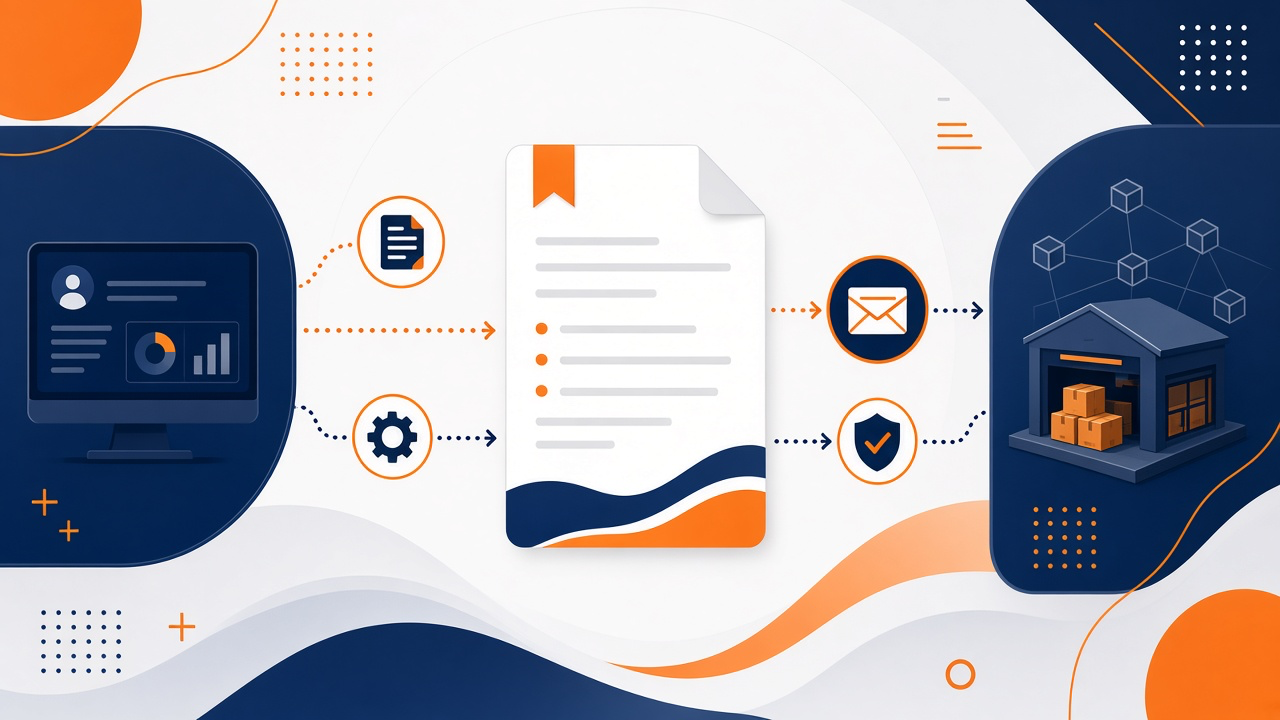
End-to-End Business Flow
Buyer ERP creates PO
    ↓
Translator maps to X12 850
    ↓
Send via AS2 / VAN / SFTP
    ↓
Supplier receives and validates
    ↓
Functional ack (997) + often PO ack (855)
    ↓
Supplier fulfills (856 ASN, then goods move)
    ↓
Supplier invoices (810) against the PO
Not every trading partner uses every document, but this is the classic retail and wholesale pattern.
Step 1: PO Creation in the Buyer System
Procurement or an automated replenishment process creates the purchase order in the ERP. Business rules check vendor contracts, budgets, and item master data before the EDI team ever sees a file.
Bad master data here—wrong UOM, obsolete SKU, stale price—will travel unchanged into the 850.
Step 2: Translation to EDI 850
The middleware or EDI translator maps ERP fields into X12 segments. Common segments include:
BEG— purpose, PO type, PO number, dateREF— reference numbersN1loops — parties and addressesPO1— line itemsCTT— control totals
Partners often require partner-specific qualifiers. A map that works for one retailer may fail for another.
Step 3: Transport and Security
The 850 is sent over AS2, SFTP, or a VAN. AS2 adds certificates, MDNs, and non-repudiation for many U.S. retail partners. Ops should track send success separately from business acceptance.
Step 4: Supplier Validation
On receipt, the supplier system validates structure and business rules:
- Known buyer and ship-to
- Items that exist and can be sold
- Quantities and dates that can be promised
- Duplicate PO numbers
Structural success (valid X12) is not the same as commercial acceptance.
Step 5: Acknowledgments
- 997 Functional Acknowledgment: “We received and could parse the interchange/group/transaction.”
- 855 Purchase Order Acknowledgment: “We accept, change, or reject the commercial order.”
Teams that only watch the 997 miss rejected lines and date changes that later cause chargebacks.
Step 6: Fulfillment and Financial Close
Accepted lines move into warehouse and shipping. The 856 Advance Ship Notice tells the buyer what is coming. The 810 Invoice should reference the original PO and quantities that match what shipped.
When 850, 855, 856, and 810 disagree, finance spends time on exceptions instead of closing the books.
Common Failure Points
- Duplicate PO numbers after ERP retries
- Quantity or UOM mismatches
- Ship-to codes the supplier does not recognize
- Price mismatch against contract
- Late or missing 855 responses
- Partial acceptance not reflected in buyer ERP
How Engineering Teams Should Support the 850
- Store raw EDI and normalized PO side by side
- Correlate PO number across 850/855/856/810
- Alert on missing acks within partner SLAs
- Provide ops screens for line-level accept/reject
- Test partner-specific maps with golden files
Conclusion
The EDI 850 is the start of a purchase lifecycle, not a standalone file drop. Treat it as a business process with acknowledgments, fulfillment, and invoicing. When the flow is visible end to end, trading partner issues become diagnosable instead of mysterious.
Connect With Us
At KIS Technology, we help businesses transform their ideas into secure and scalable digital solutions through software development, API integration, and quality engineering.
Build smarter. Build securely. Build for growth.
Connect with our Founder: