ANSI X12 Explained with 850, 810, 856 and 997 Examples
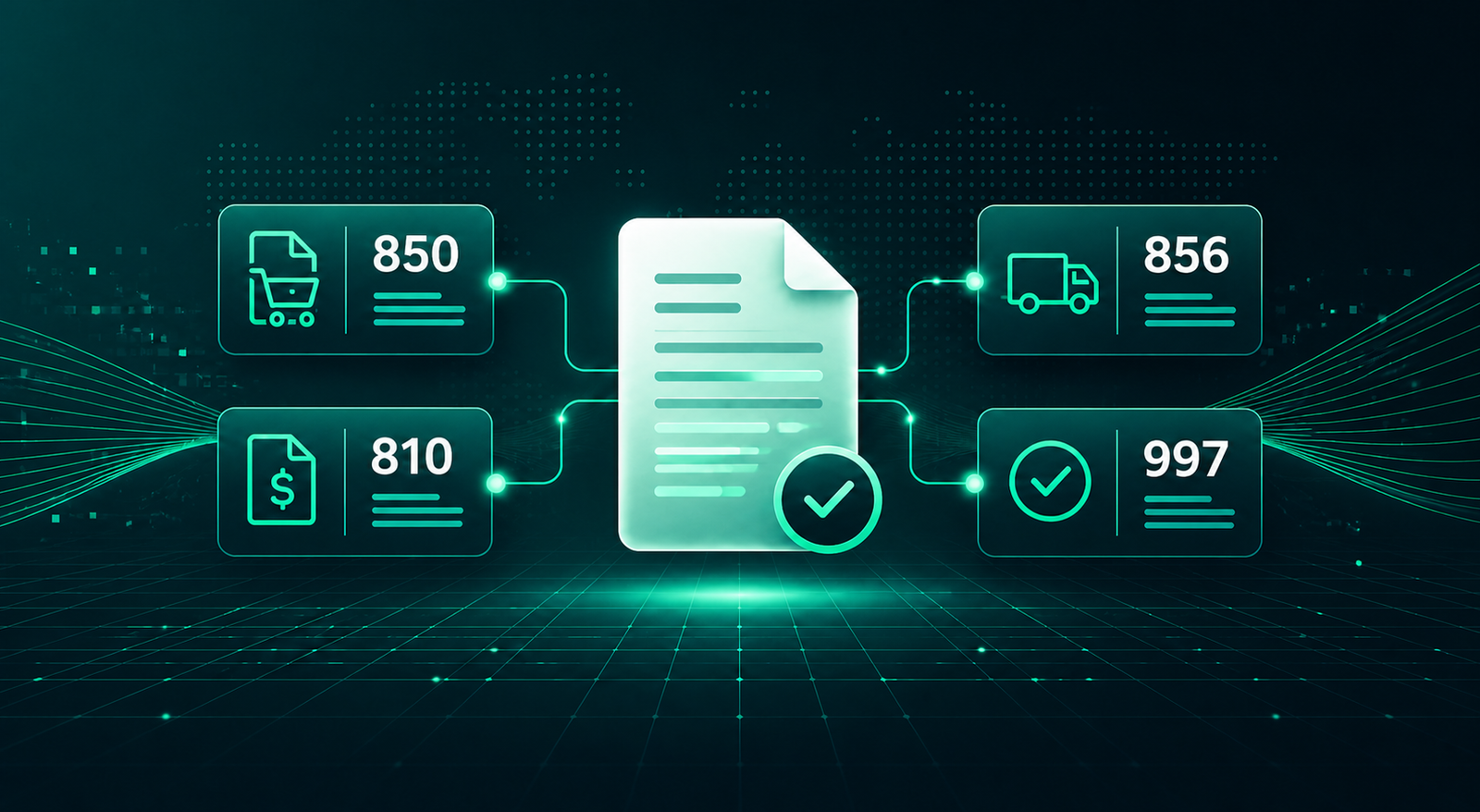
ANSI X12 is one of the most widely used EDI standards in the United States. It helps businesses exchange structured documents such as purchase orders, invoices, shipping notices, and acknowledgments in a consistent electronic format.
For companies working with retail, logistics, healthcare, manufacturing, warehousing, or supply chain systems, understanding ANSI X12 is essential for building reliable EDI integrations.
What Is ANSI X12?
ANSI X12 is a standardized format for exchanging business documents electronically between trading partners.
Instead of sending business data manually by email, spreadsheets, or paper documents, companies use X12 transactions so their systems can communicate automatically.
Each X12 document is made up of structured segments and elements. This allows different business systems to interpret the same transaction in a predictable way.
Why ANSI X12 Matters in EDI
ANSI X12 plays an important role in enterprise EDI because it helps businesses:
- Standardize document exchange
- Reduce manual data entry
- Improve transaction accuracy
- Speed up order and invoice processing
- Support large trading partner networks
In the USA, ANSI X12 is commonly used with communication protocols like AS2 and SFTP to transfer EDI files securely.
Common ANSI X12 Transactions
Many X12 transaction sets are used in day-to-day business operations, but some of the most common are 850, 810, 856, and 997.
850 Purchase Order
The 850 Purchase Order is used when a buyer sends an order to a supplier.
It typically contains:
- Buyer and supplier details
- Purchase order number
- Product or item details
- Quantity
- Pricing
- Delivery information
A simplified example looks like:
ST*850*0001
BEG*00*SA*PO12345
N1*BY*Retailer Inc
N1*ST*Main Warehouse
PO1*1*100*EA*25.00
CTT*1
SE*6*0001
This transaction tells the supplier what products are being ordered and under what terms.
810 Invoice
The 810 Invoice is used by the supplier to bill the buyer for goods or services.
It commonly includes:
- Invoice number
- Billing information
- Purchase order reference
- Item pricing
- Total amount
A simplified example looks like:
ST*810*0002
BIG*20260814*INV1001*PO12345
N1*BT*Retailer Inc
IT1*1*100*EA*25.00
TDS*250000
SE*5*0002
The 810 helps ensure that invoice data flows directly into finance or ERP systems without manual entry.
856 Advance Ship Notice
The 856 Advance Ship Notice (ASN) is sent before or during shipment to provide shipment details.
It may include:
- Shipment reference
- Carrier information
- Packing details
- Order reference
- Item quantities shipped
A simplified example looks like:
ST*856*0003
BSN*00*SHIP123*20260814
HL*1**S
TD1*CTN*10
LIN**VP*ITEM100
SN1**100*EA
SE*6*0003
This transaction helps the buyer prepare for receiving goods and improves warehouse visibility.
997 Functional Acknowledgment
The 997 Functional Acknowledgment is used to confirm whether an EDI document was received and checked structurally.
It does not confirm business acceptance of the order or invoice. Instead, it confirms whether the X12 document itself was accepted or rejected at a structural level.
A simplified example looks like:
ST*997*0004
AK1*PO*1
AK2*850*0001
AK5*A
AK9*A*1*1*1
SE*5*0004
The 997 is important in EDI workflows because it helps trading partners identify missing or invalid transactions quickly.
How These Transactions Work Together
In a common EDI flow, these documents may appear in sequence:
- The buyer sends an 850 Purchase Order
- The supplier receives it and may send a 997 Functional Acknowledgment
- The supplier ships the goods and sends an 856 Advance Ship Notice
- The supplier sends an 810 Invoice
This creates a more automated and traceable business process between trading partners.
Important Note About 997
Many businesses confuse a 997 with full business approval, but that is not what it means.
A 997 only indicates whether the X12 document was structurally received and validated. A purchase order may still be rejected later at the business or application level if item data, pricing, or partner rules do not match expectations.
ANSI X12 and Trading Partner Integration
When implementing ANSI X12 in an EDI platform, businesses usually need:
- Trading partner configuration
- Sender and receiver IDs
- Transaction mappings
- Validation rules
- Secure transport setup such as AS2 or SFTP
- Logging and monitoring
A well-designed EDI solution ensures these X12 transactions are validated, transformed, routed, and tracked correctly.
Conclusion
ANSI X12 remains a core part of EDI in the USA. Transactions such as 850, 810, 856, and 997 help businesses automate ordering, invoicing, shipping, and document acknowledgment across enterprise systems.
For companies building or improving EDI integrations, understanding these core X12 documents is a strong foundation for creating secure, scalable, and reliable B2B workflows.
Connect With Us
At KIS Technology, we help businesses transform their ideas into secure and scalable digital solutions through software development, API integration, and quality engineering.
Build smarter. Build securely. Build for growth.
Connect with our Founder: